

Volodymyr Baienko: It was a conscious step from the president - to make the team attractive to both fans and other clubs
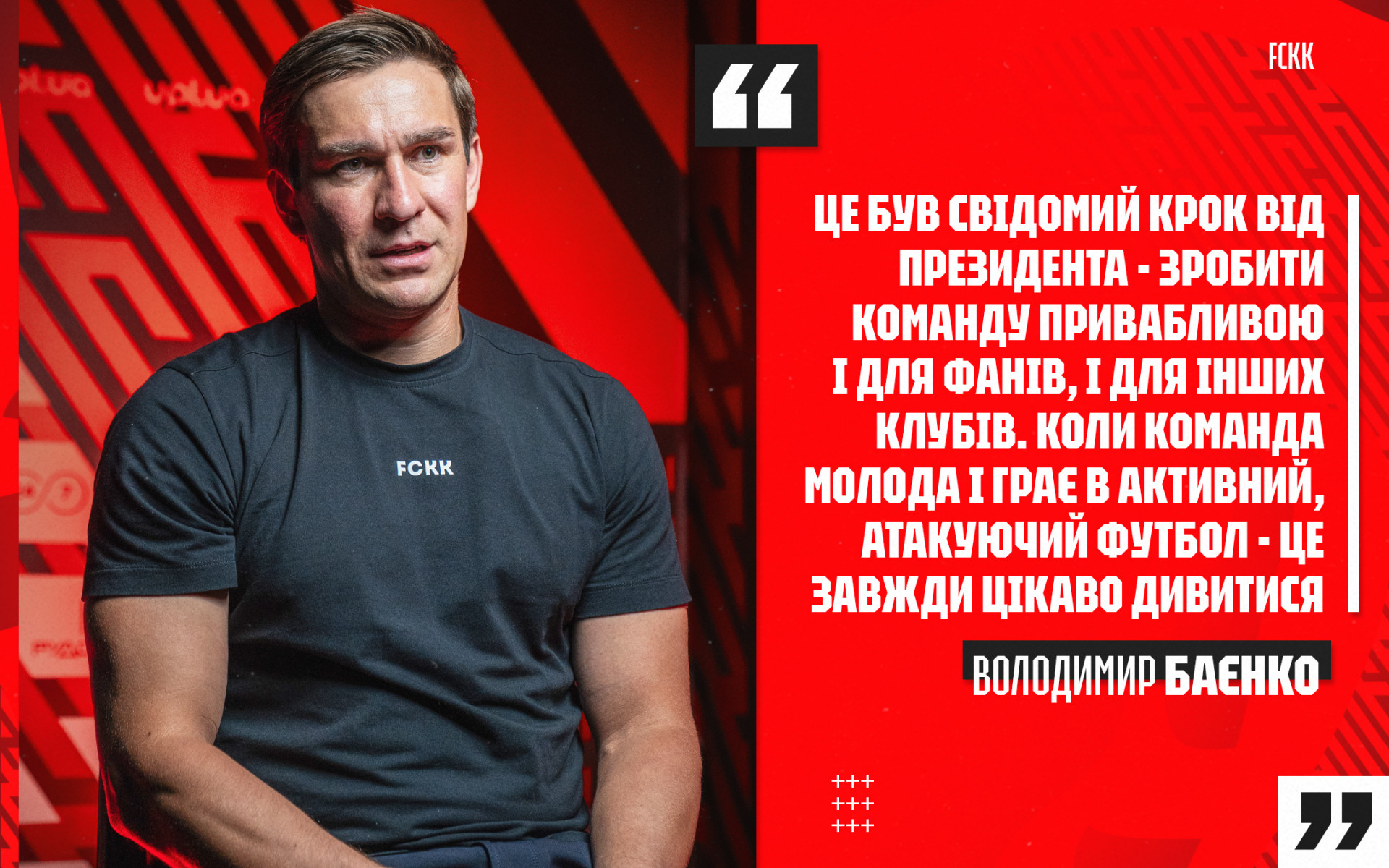
Volodymyr Baienko, CEO of Kryvyi Rih’s FC Kryvbas, shared his thoughts on the emotions ahead of the new season, transfer successes, the development of home-grown academy players, the adaptation of newcomers, and the widely debated foreign player limit.
On Expectations for the New Season and Reviewing the Past Championship
- A sense of calm always precedes the start of the championship. Once the season officially kicks off, it becomes clear how prepared the team actually is and what areas still require improvement. Any friendly fixture remains just a friendly. Only in official league competition do you realize who prepared well and how effectively teams conducted their transfer campaigns. After the opening rounds, you can react, adjust, and refine the situation.
After our opening-day defeat to Kolos last season, few expected us to lead the table by Round 10. We underwent a managerial change, working under Yuriy Vernydub, and brought in many new players. We also slightly adjusted our approach to objectives—the squad was significantly rejuvenated.
This was a deliberate decision by the club president to make the team attractive to both fans and potential buyers. When a young team plays active, attacking football, it captures everyone's interest. For clubs looking to recruit players, this is equally appealing, as young footballers represent more prospective investments than veteran players.
Perhaps no one anticipated we would perform so brightly. However, we foresaw that a younger squad would be more aggressive, open, and perhaps less consistent, but undeniably exciting. Ultimately, we achieved what we set out to do. Toward the end of the campaign, we lacked a bit of consistency to finish higher than seventh.
On the Transfer Model, Revenue, and Ukrainian Youth
- Transfers are never the work of a single individual. Identifying talent comes first—our scouting staff executed their duties exceptionally well. Following that, the coaching staff unlocked the players' potential. For instance, Mendoza played under both the previous and current staff, while Araujo and Paraco progressed very rapidly. The directive set by the president—to sign players with high market appeal—is being fulfilled. When every department performs its job effectively, the outcome follows naturally: within a single season, a player develops, attracts market interest, and allows the club to generate transfer revenue.
Our president stated from the outset that he aims to build a financially sustainable project with a young, entertaining team. Strategically, we remain fully committed to this target. This year, players representing Ukraine’s youth national teams joined our main squad. While this receives less public coverage, it holds even greater significance for us than player sales. Shevchenko and Vilivald represent the U-21 national side, alongside call-ups for Bodnar and Kamenskyi. Our young Ukrainian players are acquiring valuable international experience through the national team system.
We do not simply recruit, develop, and sell foreign players; we nurture our own Academy graduates. That remains the core foundation we aim to develop most.
Coaching Staff Dynamics: Balancing Business and On-Field Results
- Patrick van Leeuwen responded entirely professionally to the departure of key players. Everyone understood that if demand exists for our players, the club will not act as a 'golden cage'—we let them move forward. We discussed this approach with Patrick before finalizing his appointment. One of his primary directives was the development of Ukrainian talent from our Academy, given his extensive track record working with young footballers. This entails genuine technical and physical development rather than merely awarding first-team minutes. Whether a player is Ukrainian or Venezuelan is irrelevant—the priority is continuous player progression.
Naturally, our own Academy graduates remain the priority. However, when the development structure operates correctly, the entire squad elevates its level. Recently, we finalized the sales of Konaté, Mykytyshyn, Tverdokhlib, Araujo, Paraco, and Mendoza. Under Patrick’s tenure, this marks six major departures already. We strive to react swiftly and fill those positional vacancies with equivalent quality. If the valuation meets the criteria set by the club and the president, we proceed with the transaction and immediately profile a replacement with a matching skill set.
Is the economic model a higher priority than sporting success?
- I disagree with that perspective. We lacked the stability required to sustain our European qualification push into the final rounds, yet we remained in firm contention until around Round 25 with one of the youngest squads in the league. We recognize that the core of this team will consist of Ukrainian passport holders currently transitioning from our youth setups. We will build the squad around them—we haven't sold them, and they are staying with us.
We continue to recruit foreign players for specific positions, but we do not sell the core players targeted for long-term squad building. Looking two to three years ahead, once these players gain solid UPL experience and navigate high-pressure matches, we will possess a highly competitive unit. With 8 or 9 home-grown players boasting one or two seasons of top-flight experience, we can strategically integrate quality foreign signings to maximize our chances of competing for European places.
New Signings and Squad Depth
- Assigning premature praise is difficult because adaptation is a highly individualized process. Certain players adjust quickly to our intense, uncompromising style of football, while others require more time. For instance, Carlos Paraco adapted remarkably fast. Shakeone Satchwell shares a similar profile—he is an exceptionally quick and explosive player. His primary task now is adapting to our training workload and the physical intensity of Ukrainian football. He possesses attributes that could make him a compelling asset, but success depends on how rapidly he absorbs the coaching staff's tactical instructions.
Regarding Naavi, he was considered one of the top talents in his age category. He operates in central midfield, demonstrates strong ball distribution in the buildup phase, and looks to play incisive, forward passes. It will be interesting to monitor his adaptation to the local game. As for Machado, I would point to the example of Jurčec, who played almost the entire season without direct competition. Since the winter window, our target was to reinforce the right-back position. Machado is a young, pacey defender who mirrors Jurčec’s overall profile.
Is Kryvbas’s transfer business completed for the season?
- We are currently finalizing deals for two additional players, but our recruitment process remains ongoing. Following the opening matchdays, we will evaluate which positions require further reinforcement to maintain optimal competitiveness. Judging by our summer pre-season friendlies, the team displayed encouraging performances, particularly in the final stages of preparation. Physical conditioning has improved, new signings have integrated, and the overall performance level has risen.
Since we are not competing in European tournaments this season, our schedule consists of 30 league fixtures plus the Ukrainian Cup. This match load does not justify maintaining a 23–24 player squad like Shakhtar, who compete across multiple fronts. For domestic clubs without European football, a core squad of 16–17 players is entirely sufficient to navigate injuries and suspensions throughout the campaign. Unlike England, where teams face 52 matches a year plus international duty, over-expanding the squad is unnecessary.
The Debate Surrounding the Foreign Player Limit
- This remains a widely debated topic. My question to football administrators is simple: does any empirical data exist since the implementation of the foreign player limit demonstrating whether it actually benefited our national team? How is the efficiency of this regulation measured? Has the output of high-caliber Ukrainian players in the national team increased?
The rule was introduced based on certain assumptions, yet no follow-up analysis has been conducted on its actual impact. We are debating player quotas without concrete statistical evidence. Secondly, the limit has no bearing on the development of youth academies. We have been investing in and expanding our Academy for five consecutive years, irrespective of quota regulations.
In practice, the home-grown rule primarily benefits player agents, who artificially inflate market valuations and wage demands for domestic passport holders. Consequently, an average Ukrainian player can demand significantly higher compensation from a club than an equivalent player without local status.
Press service of FC "Kryvbas" Kryvyi Rih according to the materials YouTube project Re:Marka